
2 years or 3 years
September 2027
£23,000 per year
London
L57
BA01

Build your filmmaking skills, find your creative voice and prepare for your future in the industry at London Film Academy. Our BA (Hons) Filmmaking programme is an intensive, hands-on degree designed to bring you closer to the realities of professional filmmaking. Working collaboratively from the outset, you’ll gain practical experience across film production, develop your creative confidence and build the skills to take your next step, whether that’s launching your career or progressing to postgraduate study.
At LFA, you’ll learn from practising industry practitioners and benefit from our established connections across film and television. Our industry partnerships, including Focus Canning, Hollyland and Guildhall Music, help connect your learning with the professional world of filmmaking. As an ARRI Certified training institution, we also give you the opportunity to develop your skills using professional filmmaking equipment and technology.
Through hands-on production, individual guidance and a supportive, international filmmaking community, you’ll develop your strengths, explore your creative ambitions and learn how to work effectively as part of a professional production team. Throughout the BA, you’ll have the opportunity to work on up to 12 films, building valuable experience across different stages of production and developing your own creative portfolio.
You’ll graduate with practical production experience, a portfolio of completed films, a strong showreel and the foundations to build a sustainable career in film and television. Throughout your studies, you’ll also explore the responsibilities of working in the screen industries, developing an approach to filmmaking that is both ethical and sustainable.
Develop your filmmaking skills from script to screen. Our BA (Hons) Filmmaking programme offers an intensive, practical grounding in the creative and technical disciplines involved in bringing a film to life. You’ll explore screenwriting, directing, first assistant directing, cinematography, sound, editing, producing and production design, building an understanding of how each role contributes to a successful production.
Choose a two-year or three-year study route, depending on your ambitions and the experience you want to gain. Both routes offer an intensive filmmaking education, with the option to undertake a six-to-eight-week work placement on the two-year route or a full year in industry after your first year on the three-year route.
Before starting, you’ll select a pathway in factual filmmaking, narrative filmmaking or post-production, allowing you to develop specialist skills alongside a broad understanding of film production.*
The first two terms focus on story, narrative and collaboration, combining creative exploration with practical workshops. As you progress, you’ll put your learning into practice through documentary and fiction filmmaking, learning from experienced film and television practitioners and guest speakers. Their industry knowledge will help you understand the realities of professional production and give you the skills needed to work confidently as part of a filmmaking team.
By combining practical training, specialist development and industry experience, the programme prepares you for a career in film and television or further study at master’s level.
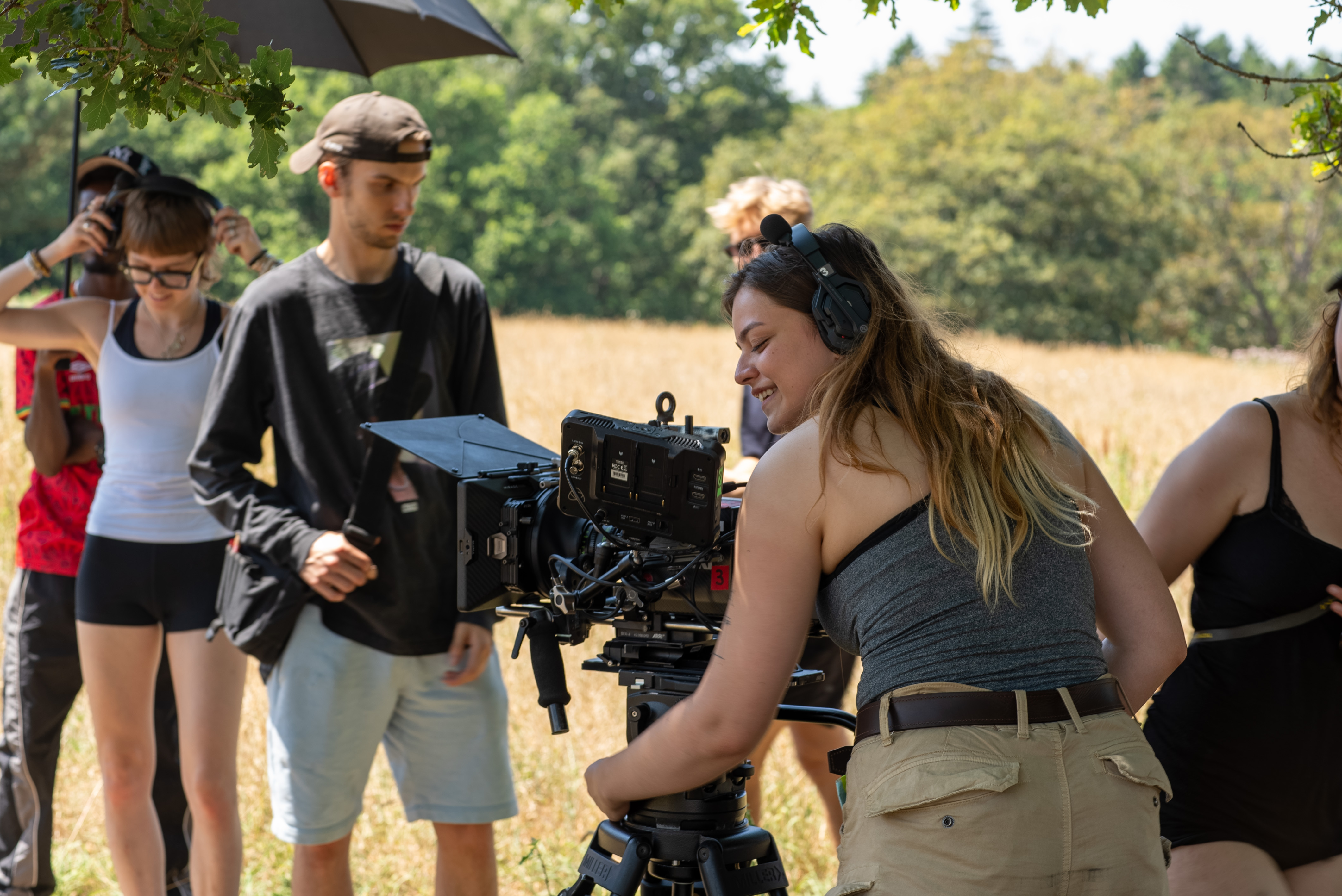

Students choose their specialist pathway before starting the course, these include:
Build fictional worlds, write compelling scripts and direct actors to bring your creative vision to life. Ideal for aspiring directors, screenwriters and storytellers who want to develop their cinematic voice.
Tell real-world stories through documentary, unscripted and creative non-fiction filmmaking. Ideal for filmmakers drawn to people, ideas, real events and stories that have something to say.
Master the craft of editing, colour grading and sound to control pace, emotion and meaning. Ideal for creative problem-solvers who thrive in the edit suite and want to shape footage into a finished film.
Whichever pathway you choose, you’ll continue to collaborate across the filmmaking process, developing the creative, technical and professional skills needed to move confidently into the industry.
Build a strong foundation in the creative and technical skills behind filmmaking, including visual storytelling, scriptwriting, directing, cinematography, lighting, production design, sound recording and editing. Learn industry-standard equipment and software and explore the roles and responsibilities involved in bringing a film to life.
Put these skills into practice through LFA’s Super Short Film Project, a two-minute short film production cycle in which students rotate through a range of creative and technical crew roles. Working collaboratively, students develop, produce and a series of short films on s16mm film, gaining hands-on experience of analogue filmmaking, professional on-set workflows and real-time feedback from industry practitioners.
Put your developing skills into practice through your chosen pathway. Whether creating a film through Narrative filmmaking, developing real-world story through Factual Filmmaking or shaping a production through Post-Production, you’ll deepen your specialism, through practical, industry focused projects.
Alongside this, explore filmmaking ethics, professional responsibilities, equity, diversity and inclusion, industry practices and the realities of working in the film and screen production.
Bring your skills, experience and creative vision together in a final major project. Explore a research question linked to your career ambitions through a filmmaking project, an eight-week work placement or an individual creative artefact. Reflect on your achievements, develop a professional digital portfolio and showreel, and graduate ready to showcase your talent and take your next step into the film and screen industries.
The three-year BA (Hons) Filmmaking degree follows the same programme structure and specialist pathways as the two-year accelerated programme, with one key difference: an additional one-year professional work placement after Term 4.
After completing Term 4, students undertake a one-year work placement, gaining extended experience in the professional film and screen industries before progressing to Term 5 & 6 and completing their final major project.
LFA works with over 40 placement providers across a range of sectors, offering opportunities with organisations including Panavision, Film London, Apple TV and the London Screenwriters’ Festival. Students can also source their own placement. LFA supports students throughout the application, interview and onboarding process, helping them prepare for professional working environments and build valuable industry connections.
A year in industry provides the opportunity to develop practical skills, expand professional networks and gain a deeper understanding of the sector. It is not uncommon for placement providers to offer students professional roles following their placement.
Choosing the three-year route: Students interested in the extended one-year work placement should select the relevant option on their LFA application form when applying for the BA (Hons) Filmmaking degree.
A BA (Hons) in Filmmaking can open doors to a wide range of careers across the film, television and wider screen industries.
Whether you aspire to direct films, develop compelling stories, work behind the camera or shape the final edit, the practical and collaborative nature of the programme will help you build the creative, technical and professional skills to pursue your ambitions.
Depending on your chosen pathway and developing specialism, potential career opportunities include:
Graduates may also explore opportunities in commercial filmmaking, music videos, branded content, digital media and independent production.
Learning at London Film Academy is practical, collaborative and informed by the realities of the film industry. You’ll learn through a combination of interactive lectures, seminars, workshops, screenings and hands-on filmmaking projects, supported by experienced industry professionals.
As you develop your creative, technical and academic skills, you’ll work both independently and collaboratively, applying your learning across different stages of the filmmaking process. Your progress is supported through regular guidance, assessment and constructive feedback, helping you recognise your strengths, develop your craft and build confidence as a filmmaker.


Gain hands-on experience across directing, screenwriting, cinematography, sound, editing, and production, learning the complete filmmaking process from script to screen.

Thrive in an intimate learning environment with personalised feedback and a strong staff-to-student ratio that ensures your creativity is nurtured.

Be taught by working filmmakers, producers, and editors using professional equipment and the latest techniques from film and TV production.

Shoot on industry-standard cameras such as the ARRI Alexa, and gain technical confidence using professional lighting, sound, and post-production tools used on major film sets.

Build experience and connections through real-world placements with leading UK companies like The Imaginarium, Evolutions, and Creativity Media.

Connect with industry professionals and showcase your work at national film and media events, expanding your network and opening doors to future collaborations.

Receive tailored guidance, mentorship, and career support to help you transition confidently from student filmmaker to industry professional.

Work as part of a film crew, developing teamwork and communication skills essential for success in today's collaborative screen industry.

Gain access to the LFA Filmmakers' Community and continue to collaborate with LFA alumni and fellow professionals.

UCAS Tariff Points: 96-112
A-levels: 3 A-Levels minimum BBC (preferred subjects: Art & Design, Photography, Film & Media Production, Film & Media Studies, Drama, English)
GCSE: at least 3 GCSEs at Grade 4/Grade C (or above) including Maths and English or equivalent qualification
Exceptions: Exceptions apply for applicants aged 21 or above, who may be considered through the experience route. To qualify, candidates must have 4-5 years of professional experience with established production companies or charitable organisations, demonstrating exposure to industry...

Until 17 Dec 2027
Until 10 April 2028
Until 11 Aug 2028
Register and submit your application through our online registration page. You’ll receive an email confirmation with next steps. You’ll also need to complete your UCAS application at UCAS.com.
Show us your passion for film. Upload a portfolio or creative work such as a short film, photography project, or screenplay, this helps us understand your storytelling style and creativity.
Once we’ve reviewed your materials, successful applicants will be invited to an online interview. This is your chance to discuss your ideas, inspirations, and filmmaking goals with our tutors.


-around with other passionate film makers and other strong collaborators. It’s solidified my concept of collaboration in the industry.”

Two years ago, if you had told me I’d be looking for producing jobs when I leave LFA, I’d have said, ‘No way.’ And now, here I am!”

-and people that are all willing to make a film with you."

Yes, the budgets for all film projects on our programmes and courses are included in the overall fees. There are no hidden fees or extra costs with any LFA course.
If your application has been successful, and you have secured your offer and paid the required non-refundable deposit, we may be able to set up a Payment Plan to allow you to pay your course fees in instalments. Please contact the Admissions team directly via email - admissions@londonfilmacademy.com - to find out the application criteria and application process. Please note that Payment Plans are subject to approval and payment of the Payment Plan Administration Fee payable prior to issuing.
UK-based undergraduate students can apply for Student Finance. As LFA is an independent education provider, Student Finance will provide £7,420 per year of Student Loans to LFA students, and typical maintenance grants of at least £3,000 per year based on your personal circumstances. Therefore, please note that this loan does not cover the full tuition fees.
You can find out more about the Student Finance process by visiting the UK government website. When applying for your Tuition Fee Loan, you must enter the amount of £7,200 for your application to be valid.
If you plan or need to get a part time job to help support yourself financially with the cost of living in London, please be aware that LFA courses are intensive and may require attendance during evenings or weekends, so any part-time work which you commit to should not interfere with attending classes or monitoring, and that this should only be supplementary to your studies.
International students may be allowed to work part-time, depending on which programme you’re studying and whether you’re working in or out of term-time. If your application is successful, you’ll be told what you can and cannot do workwise on your Student visa. For more information, visit this page on the UKCISA website.
After graduating from LFA, you will have access to the LFA Filmmakers’ Club, connecting you with fellow students and alumni worldwide. This club acts as a central hub for ongoing collaboration, learning, and career advancement in filmmaking. As a member, you'll enjoy benefits such as:
While we do not provide student accommodation ourselves, we offer valuable guidance on finding safe and affordable housing in the vicinity of our LFA building in Fulham, Southwest London. Explore our accommodation webpage, and read our top tips and advice for accommodation on the LFA blog.
Due to the significant demand for affordable student housing in London, we advise securing accommodation early to avoid any inconvenience. Please note that arranging accommodation is the responsibility of the students.
Our BA (Hons) Filmmaking and MA Filmmaking programs are designed to provide you with a comprehensive understanding of all facets of the filmmaking process, encompassing diverse disciplines and practices. Upon completion of these courses, you will emerge as a versatile, multi-disciplinary professional, significantly enhancing your employability prospects within the industry due to your extensive knowledge and skills.
Our MA Screenwriting course specialises in screenwriting. Several of our short courses specialise in specific disciplines.
LFA is a registered higher education provider with the Office for Students (OfS) and listed on their Register, meaning that we meet the OfS requirements for academic standards, course quality, student support, and student protection. This course is validated by the University of Derby. As a partner student you will be granted access to the University’s online learning environment ‘University of Derby Online (UDo)’ where you will be able to access programme resources related to your programme, the University’s library and your grades.